Build a Spike, Not a Triangle
by Henrik Holen on Tue Dec 16 2025
“If you’re not embarrassed by your first release, you released too late.”
People have been saying that for decades, but the second someone with no coding skills could make their idea come to life, people started crawling out of the woodwork yelling about scalability and technical debt. Those same people started their careers by cobbling together their auth flows from a tutorial written in 2014.
You shouldn’t worry about it.
The absolute worst thing that can happen is that nobody ever visits your site. The second worst is that you accidentally added your OpenAI API key to the frontend code, but as long as you didn’t turn off the spend limit, you’re out a hundred bucks at most.
We’ve been talking about launching minimum viable products since before Eric Ries published Lean Startup back in 2011. Now, AI coding tools enable everyone with an idea to create, launch, and test that idea. The goal has always been to create the smallest thing that helps you prove or disprove your assumption. Not to build feature-complete software. Not to architect for imaginary scale. Just to figure out if you’re solving a real problem for real people.
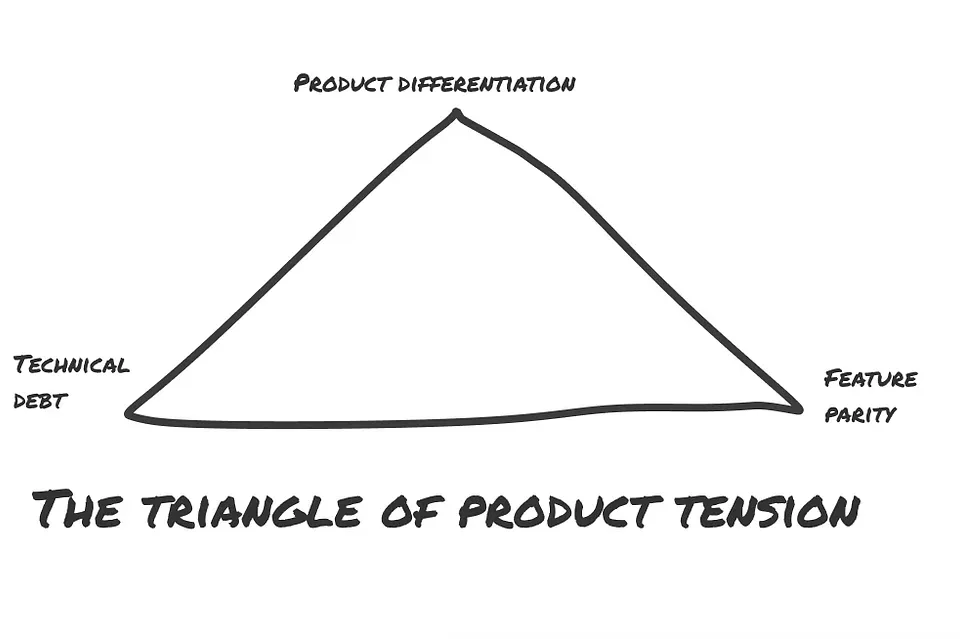
The Triangle of Product Tension
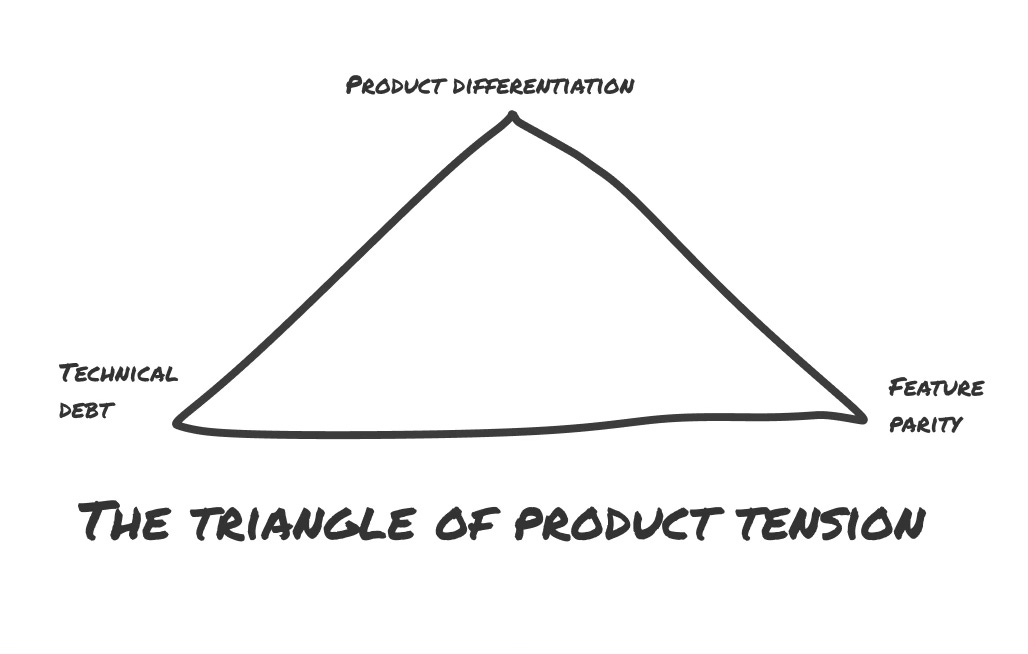
All companies live in the tension space between differentiation, tech debt, and feature parity. You need to invest in maintaining technical debt to make sure you have a modern and stable solution. Feature parity is necessary to grow horizontally and become competitive at a larger scale. Product differentiation is, well, what makes you different.
In a mature company, you balance all three. You can’t ignore any side of the triangle for too long without consequences. But for a startup with no revenue, no costs, and no customers, none of that matters.
What You Should Actually Do
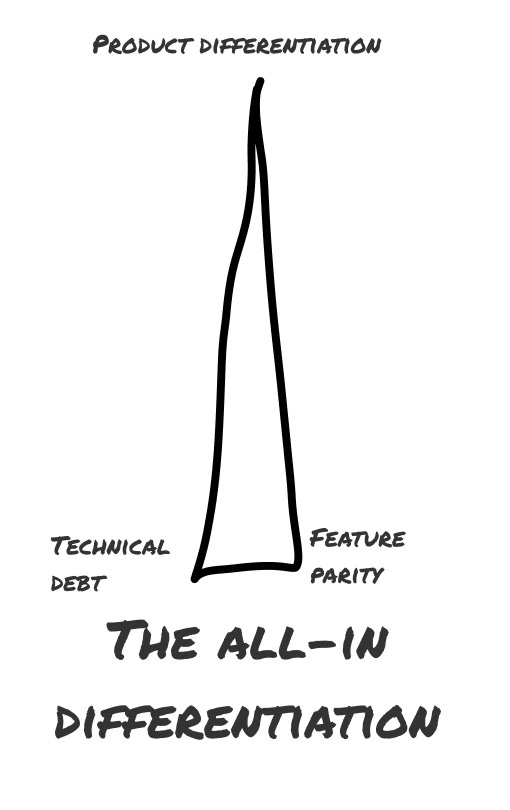
What a startup needs to do is create the narrowest, tallest, and spikiest thing they can, and then keep building that spike.
For any chance at success, your product needs to be an order of magnitude better at a very narrow thing, and all your efforts should be invested in that differentiation, not in your future problems.
This is what Peter Thiel calls going from “zero to one” instead of “one to n”. You’re not trying to do what everyone else does, just slightly better. You’re trying to do something new that makes a huge difference to a small group of people.
For 99% of startups, you’ll be competing in a space where you have large incumbents. There are some things that they’ll be incredibly good at, so you need to focus on the edges of their triangle, hitting the points where you can differentiate.
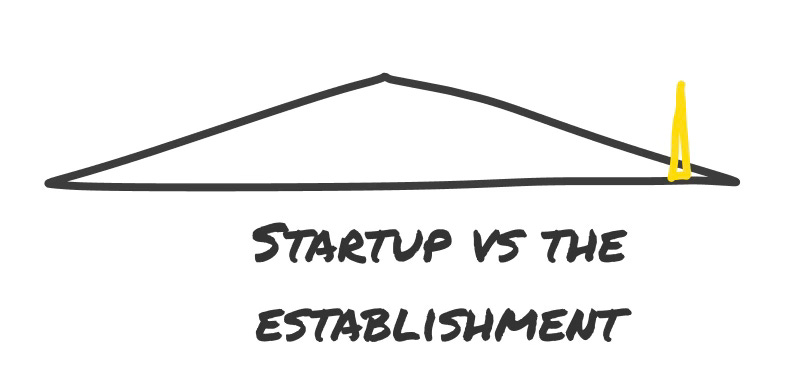
Think about the incumbents. They’ve spent years building feature parity with their competitors. They’ve got entire teams managing technical debt. Their triangle is wide and stable, but that means they’re spread thin. They’re good at everything, but perhaps not incredible at them.
That’s your opening. Find the job-to-be-done that they’re serving adequately but not exceptionally. Then build something that does that one job so much better that downsides become irrelevant.
At the start, Google Docs couldn’t do half of what Word could. Its formatting was janky, it couldn’t handle complex documents, and it had no offline mode. But it did have a link where people could _s_ee your edits in real time. And it turned out not having to email v7_final_FINAL.docx back and forth was so valuable that some people happily gave up most of the features in Word.
Early Spotify had inconsistent audio quality, a limited catalogue, and a free tier with an silly amount of ads. But there was instant access. You thought of a song and you were listening to it three seconds later. No buying albums, no syncing your iPod, no sketchy torrents. The instant gratification was enough to make enough people tolerate everything else.
For most people, your product will seem like a toy, useless compared to the balanced triangles your giant competitors have. That’s a challenge to overcome, but once you do, they can’t move fast enough to out-spike you.
When Your Tower Starts to Wobble
At some point, your spiky tower will start to wobble, and if you’re lucky, that’ll worry you, because your tower is now so tall and big that it’ll actually make an impact when it hits the ground.
But here’s the thing: your tower isn’t big because you over-engineered it. It’s big because you have customers who love it. People are using your wobbly, duct-taped-together spike because it solves their specific problem 10x better than anything else out there. The wobble isn’t happening because you failed to plan, it’s wobbling because you have product-market fit.
At that point, start thinking about technical debt. Start building feature parity to widen your base. But not before. You don’t have to worry about these things before building something people actually want.
The Tiny Enterprise Company Trap
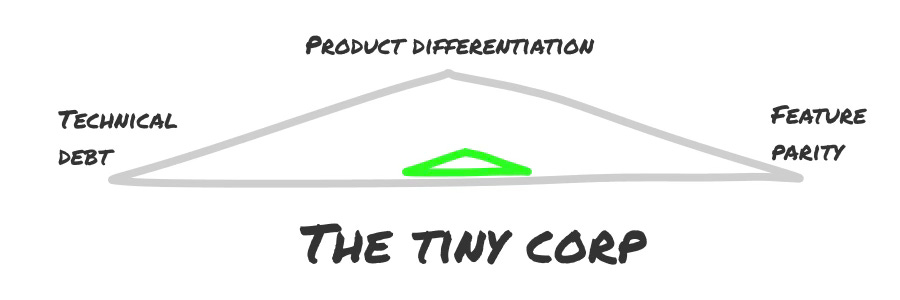
Some startup founders will try to balance the triangle, making sure that they have feature parity and minimal tech debt from day one. They try to build a tiny enterprise company. Tiny being the key word.
Instead of breaking out of the shadow of the giants, they just become a tiny copy that no one wants. They’ve built a perfectly balanced triangle that’s so small it doesn’t matter.
The giants have balanced triangles. They’re not worried about your smaller balanced triangle. They might worry about a sharp spike though.
Ship It
Build your rickety tower. Ship something you’re embarrassed by. Don’t worry about the potential security issues. Let it wobble.
Your only job is to be 10x better at one thing that matters. Everything else is a future problem, and future problems are luxuries that successful companies get to have.
Subscribe to my newsletter
Get my latest thoughts on product and strategy delivered to your inbox.