Is Your Product a Homework Assignment?
by Henrik Holen on Tue Jan 13 2026
You know your product. Every feature, every quirk, the history behind why that button lives where it does. You’ve internalised the workarounds. You navigate the rough edges without noticing them. You’ve already bought the value proposition of course, you’re spending your life building the thing.
So when someone doesn’t get it - bounces off the landing page, goes quiet after a demo, asks something you’ve answered a hundred times - it confuses you. You’ve explained it clearly. The value is right there. What are they missing?
This is the curse of knowledge - a cognitive bias where once you know something, you can’t imagine not knowing it. The term comes from economists in 1989, but the best demonstration is simpler: in a famous experiment, people were asked to tap out well-known songs while others tried to guess them. Tappers predicted listeners would get it right about half the time. The actual success rate was 2.5%. Once you hear the melody in your head, you can’t imagine silence.
Knowing this doesn’t fix it. Research shows the bias doesn’t shrink when you’re told about it, or when you try harder to consider the other person’s perspective. Financial incentives don’t help either. The curse sticks.
You’re tapping out a melody on your keyboard and you can’t understand why your users only hear noise. To fix that, you need to understand where they’re standing.
Comfort, stretch, panic
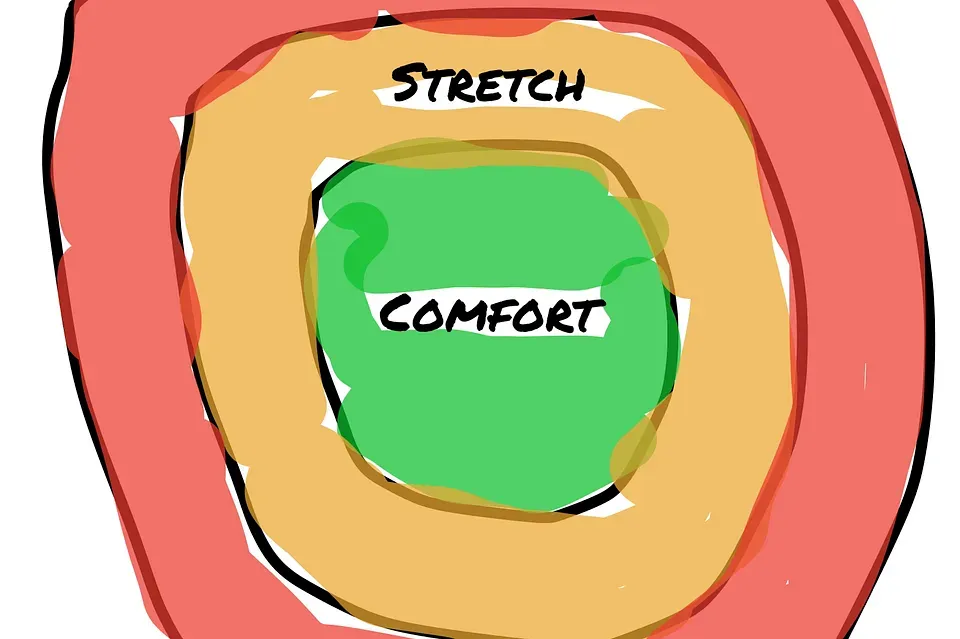
There’s a framework from psychology that helps. Three concentric circles representing how people experience challenges.
The inner circle is comfort - call it green. Familiar territory. You know what you’re doing. No strain.
The middle ring is stretch - orange. Things are harder here, but manageable. You’re learning, growing, being pushed - but not overwhelmed. This is where development happens.
The outer ring is panic - red. For many things in life, this is a racing heart, fight-or-flight. In software, it’s just the bounce. A microsecond of feeling stupid, then the tab closes. Users will pay for value, but they won’t pay in the currency of feeling dumb. They just leave.
The goal, when you’re helping someone learn or adopt something new, is to keep them in the middle ring. Push past comfort, but never into panic. Hit the orange circle - that’s where growth happens.
This is what mastery does: your comfort zone expands to cover the entire product. To the expert, a complex configuration is just how it works. To the user, it’s a hurdle they didn’t ask for. What feels like a gentle stretch to you - “just connect your account and configure the settings” - might be panic for someone seeing it for the first time.
Everyone’s circles are different
The zones aren’t fixed. They vary wildly by person.
Someone technical might find your API intuitive. Someone in ops might find it terrifying. A power user who’s been with you for years has a completely different set of circles than someone evaluating you for the first time. Someone with bandwidth and focus experiences your product differently than someone already juggling fifteen priorities.
You’re not just miscalibrated about your own distance from users. You’re often assuming all your users are in the same place as each other. Designing for one persona’s circles, then shipping to everyone.
So the question becomes: what you’re asking them to do - is it comfortable, stretching, or panic-inducing for them? Not for you. Not for your most engaged customers. For the specific person in front of you right now.
When these differences go unnoticed, the user stops seeing a solution and starts seeing a burden. Usually in one of two ways.
Two ways this breaks
The cognitive cost of the product. The expert’s knowledge has become invisible to them. What feels like a simple step requires context the user was never given. The product triggers panic - too many features visible at once, too many decisions required before they can get any value. Terminology, mental models, context the user doesn’t have.
This is the classic onboarding problem. You’ve built something that makes sense to you because you’ve been there the whole time. But for someone new, there’s no orientation, no foundation, no obvious starting point. Just a wall of capability that feels impossible to climb.
The operational cost of the interaction. You’ve assumed time they don’t have. The product might be simple, but engaging with it has a cost. Evaluating a new tool takes bandwidth. Making a decision to switch takes energy. Every ask, even a small one, requires them to care about something new when they’re already stretched.
The gap between what you think you’re asking and what it actually costs them is enormous:
“Just hop on a quick 15-minute call.” You think: easy, low commitment. They feel: find a slot in my calendar, prep for a sales pitch, give up my only focus block today, then spend mental energy afterwards deciding if I want to continue. That’s not 15 minutes. That’s an hour of cognitive overhead, minimum.
“Try the free trial, no credit card required.” You think: frictionless, nothing to lose. They feel: another login to remember, another tool to evaluate, another decision I have to make when I already have twelve tabs open and a deadline tomorrow.
“Let me send over some documentation.” You think: helpful context. They feel: homework.
This isn’t panic in the same way as product overwhelm. They don’t feel stupid. They just hit capacity and quietly close the door. Your email goes unanswered. Your demo gets rescheduled indefinitely. Your product sits in the “maybe later” pile forever.
You can’t see how full their plate is because yours only has one thing on it.
Finding the signal
You can’t think your way out of this. The bias is stubborn. Telling yourself to “consider their perspective” doesn’t work. You’ve tried, and you’re still wrong.
What works is learning to read the signs you’re currently missing. Start with the silent no.
“This looks great, let me circle back next month.” That’s not interest - that’s panic dressed up as politeness. They’re not busy; they’re overwhelmed by the ask and too polite to say so. Same with “let me loop in my team” or “send me some more info and I’ll take a look.” These are exit lines, not next steps.
Your intuition wants to protect you. It says they’re just busy, or not the right fit. But the user’s experience tells a different story: they hit red, and they went looking for someone who’d keep them in orange.
Watch for the hover. When someone’s mouse stops moving, when their eyes scan the screen without clicking, they’re not exploring. They’ve hit the edge of what they understand and they’re waiting for a sign of what to do next. If they don’t find it, they leave. They’ll say “this is really cool” and then never log in again.
The curse of knowledge is permanent. But you can learn to spot the gap between what people say and what they feel - if you stop trusting your intuition and start looking for the homework you’re accidentally assigning.
Subscribe to my newsletter
Get my latest thoughts on product and strategy delivered to your inbox.