Responsive Doesn't Mean Yes
by Henrik Holen on Tue Dec 23 2025
Startups don’t win enterprise deals by acting like tiny corporates. They win through asymmetry. A tiny team lacks the global support and legacy brand of a 10,000-employee vendor, but they compensate with deep focus, high speed, and immediate access to the people making decisions.
In these deals, the product will get you through the door, but it is rarely the only thing being evaluated. The customer is also choosing an engagement model. They’re opting out of the incumbent’s bureaucracy, where simple requests are queued for months, and choosing a partner who can ship changes in a week.
The startup’s roadmap reflects the conviction of a founder who’s actually in the room, rather than a committee compromise filtered through product marketing. There is real influence to be had for the right customer.
This responsiveness is a competitive advantage during a sale, but it creates a difficult tension after the deal closes. The challenge is maintaining that speed without letting a single customer’s demands dictate the entire product roadmap.
Winning the deal creates a paradox. The very responsiveness that got you in the door is exactly what will try to pull your product apart. To win, you acted like a partner who listened, adapted, and moved fast. But once the contract is signed, the customer will try to treat you like an extension of their engineering team rather than a product company. Without being careful, the startup transitions from being a product company to a service provider.
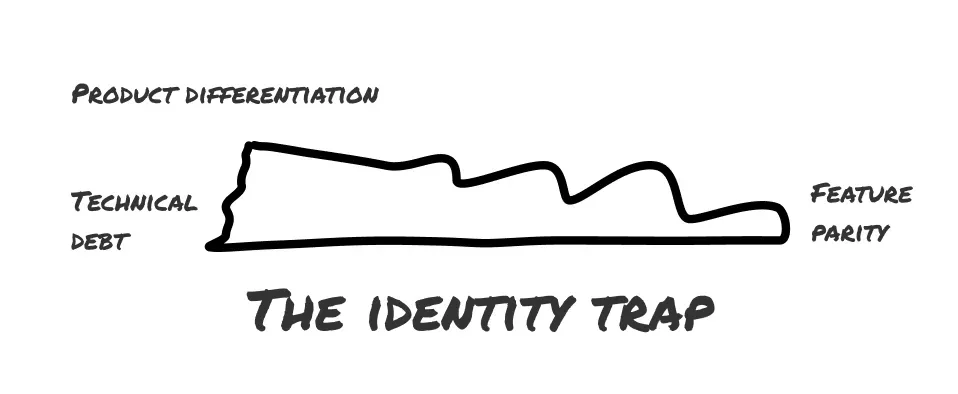
If you start morphing to fit the customer’s org chart, you aren’t being responsive. You’re being a consultancy. You lose focus because your product becomes a patchwork of one-off features. Instead of a solid spike, you end up with many small bumps, each one a concession to a different customer. Then you lose adaptability because you’re too busy maintaining those features to ship anything new.
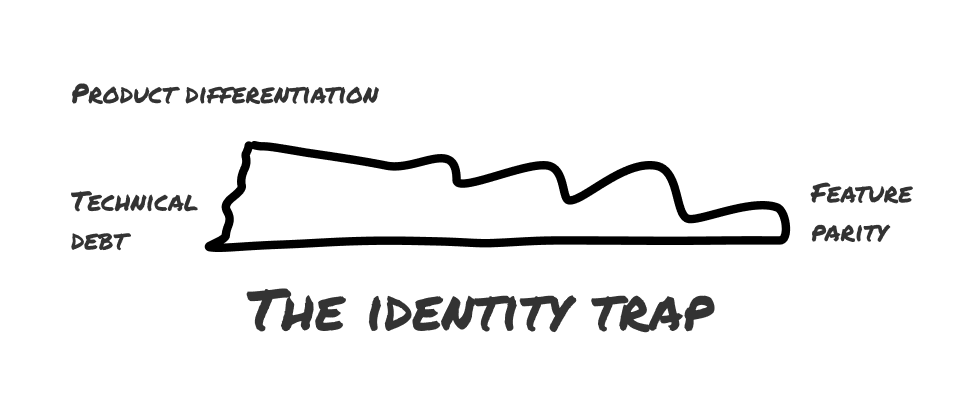
Then you lose adaptability because you’re too busy maintaining those features to ship anything new. The moment you start acting like a smaller version of the incumbent, you’ve surrendered the advantages that got you in the room.
The mistake is thinking that responsiveness requires saying yes.
You need to think about responsiveness as speed of engagement, not speed of capitulation. An incumbent takes ages to tell a customer “we’ll review this in next quarter’s planning” via a support ticket. A startup can take three hours to have a real conversation about why the answer is no, and what the alternative is. The CEO is in the meeting. The developers are thinking about it within a week. That’s responsiveness.
The key is treating the request as a problem to understand, not a feature to evaluate. What are they actually trying to accomplish? Can your product solve it a different way? With the right approach you’ll get a positive response to saying: “We won’t build a custom UI for your internal approval flow. But here’s how to use our existing webhooks to trigger that flow on your end.”
You haven’t built a one-off feature. But you’ve engaged with the problem faster and more thoughtfully than a giant vendor ever could. The key is framing alternatives around what your product already does or will do for everyone, not what you could build just for them.
You’re still the partner. You’re just not the servant.
Winning the deal is offence. It requires focus and speed to outmaneuver the giants. Surviving the deal is defence. It requires the discipline to protect your product from the very people who bought it. You win by being fast, but you survive by knowing exactly what you will never change, no matter how big the check.
What happens when you don’t hold this line, and instead say yes too often and accumulate commitments you can’t sustain, is a different kind of problem. I’ve called it Promise Debt, and it’s worth understanding before you sign your next enterprise contract.
Subscribe to my newsletter
Get my latest thoughts on product and strategy delivered to your inbox.