Taste and Distribution
by Henrik Holen on Tue Feb 10 2026
This week, I used Claude, Remotion, and ElevenLabs to produce a marketing video for a product I’m building. The voiceover was polished. The pacing was clean. It looked and sounded like any professional marketing video.
And that’s the interesting part. Not that it was impressive, but that it was normal. A year ago, this would have cost a few thousand euros and a couple of weeks of back-and-forth with a production company. Now it’s an afternoon. The same week, I’d built the product itself with AI tools. The thing and the thing that sells the thing, in the same flow.
That changes what “professional quality” actually signals.
Everyone can build now. So what?
The conversation about AI making it easy to build products is already stale. If you have a clear idea, you can get to something solid remarkably fast. But the part that hasn’t sunk in yet is that the same applies to everything. The landing pages, the onboarding sequences, the demo videos. The same tools that build the product build everything around it.
For years, the ability to ship was itself a competitive advantage. A team that could actually execute had an edge over one that couldn’t, regardless of whether the underlying idea was any good. That buffer is disappearing. When everyone can build, and everyone can market, you end up with a lot of products built to the same clean, professional baseline. They all look good. They all work. And most of them don’t matter.
What separates the ones that do? Two things: taste and distribution.
Taste as conviction
Here’s something worth sitting with: the content we call “AI-generated” is mostly just what professional content has always looked like.
LinkedIn posts that read like AI? That’s what high-performing LinkedIn posts looked like before AI wrote them. The broetry, the performative vulnerability, the “here’s what I learned” structure. Those patterns existed because they got engagement. AI didn’t invent that voice. It learned from the content that was most visible and most replicated, and now it can produce it on demand. The polished voiceover on my marketing video? That’s what professional voiceovers have always sounded like. The clean SaaS landing page? That’s what a competent agency would have delivered.
What we’re noticing isn’t a new “AI aesthetic.” It’s the sudden abundance of a professional standard that used to be expensive enough to be rare. When producing that level of quality required money and time, having it meant something. Now that anyone can get there in an afternoon, it’s just the baseline. And a baseline, by definition, doesn’t differentiate.
This is where taste comes in. People use it interchangeably with product sense now. Both describe the ability to look at a problem and understand what matters. What to build, what to leave out, what makes the difference between something people tolerate and something they choose.
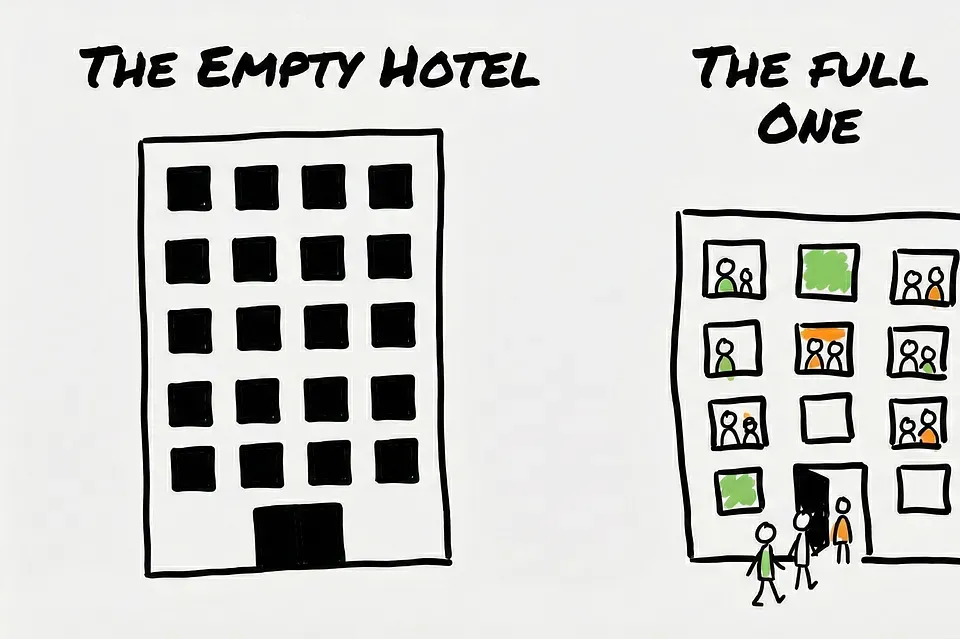
Think about the wave of Linear clones over the last few years. Every new dev tool adopted the same dark mode, the same typography, the same Command-K shortcut. AI can replicate that aesthetic easily. But most of these tools feel like empty hotels. They have the appearance of a high-performance product without the opinion that makes the original work. Linear didn’t succeed because of dark mode. It succeeded because the team had a conviction that speed was the only thing that mattered, and they made every design decision follow from that. Copying the pixels is straightforward. Copying the conviction is where most builders fail.
That’s what taste comes down to. Not polish. Not best practices. It’s having a strong opinion about what your product should be, and being willing to make the sacrifices that follow. What does this experience need to feel like? What am I willing to give up to get there?
You can develop this. It comes from curiosity, from studying why things work, from building and shipping and watching real people use what you’ve made. But it also requires the courage to be specific when the tools make it easy to stay generic. The professional baseline is a useful starting point. It becomes a trap when you mistake it for a destination.
The product is the distribution
Taste gets you something worth using. Distribution gets someone to use it.
There’s been a lot of talk about the one-person billion-dollar company. One builder with AI, creating and scaling a product solo. It’s a real trend in the micro-SaaS world. But there’s a quiet assumption in most of these success stories: the people pulling it off almost always had an audience before they had a product. A Twitter following, a LinkedIn presence, a newsletter. The building is real, but the distribution was already solved.
For everyone without an existing audience, distribution is the harder problem. And this is where the old divide between product and marketing falls apart.
The useful framing is that the product itself has to generate its own distribution. The onboarding is marketing. The aha moment is the pitch. The email you send a churning user is a product decision. If the output your users create is visible to non-users, that’s distribution. If the free tier gives someone a genuine reason to pull your product into their workflow and then bring colleagues along, that’s distribution too.
This doesn’t have to mean viral loops. An accounting tool for solo entrepreneurs doesn’t need to spread. It needs to be so clearly built for that specific person that when they open it, there’s no convincing needed. It only cares about their problems, and that’s obvious within thirty seconds. The specificity is the distribution. When the product is unmistakably for you, it converts on contact.
When you think about it this way, treating product and marketing as separate workstreams stops making sense. They’re one continuous problem.
What’s left
This obviously doesn’t apply to everything. Deep tech, complex infrastructure, complicated enterprise sales processes: these still need large, specialised teams. But for a growing category of products, particularly product-led ones where the customer finds value on their own, one or two builders with AI can cover what used to require a much larger team.
The tools will keep getting better and the baseline will keep rising. What won’t get easier is having a strong opinion about what’s worth building and knowing how to get it in front of the right people. The good news is that the feedback loop for developing both is faster than it’s ever been. You can build, ship, and see what happens in days rather than quarters. That speed is how you develop better judgement for the next thing you build.
One is taste. The other is distribution. And increasingly, they’re the same skill applied to the same problem in the same flow.
Subscribe to my newsletter
Get my latest thoughts on product and strategy delivered to your inbox.