
A startup succeeding at all is a miracle. Most of them die, and the ones that live usually needed at least one wildly improbable thing to go right. Every layer of newness you add is another one. New technology is a miracle. A new market is a miracle. A new business model is a miracle. And they multiply rather than add, stack three coin flips and you’re at one in eight.
The idea is called miracle counting, someone mentioned it to me in passing years ago and it never left me. Antonio García Martínez asks the question directly in Chaos Monkeys: how many miracles have to happen for this to succeed? If the answer is zero, you’re running a regular business. The standard advice, from Elad Gil and Todd Masonis, follows straight from the maths: you get one. Spend it on the thing that defines the company and make everything else boring.
It’s good advice, but the companies that make huge differences ignored it. Elon Musk might be awful, but he stacks miracles and clears the stack, new technology, new market, new sales model, all in one company, twice. Some things you want to build simply need several miracles, and refusing to stack them means refusing the ambition.
So the useful question isn’t whether to stack. It’s two other questions: how many of your miracles have to be true at the same time, and how many of them are yours to make true?
Two questions, four kinds of trouble
A miracle you control yields to effort. Reusable rockets are a controlled miracle, you can grind at them in stages, prove them in a lab, fail and retry on your own schedule. A miracle you don’t control, consumer readiness, a market’s timing, someone else’s users falling in love with your product, doesn’t care how hard you work. Attempts at a controlled miracle build on each other, attempts at an uncontrolled one just start over.
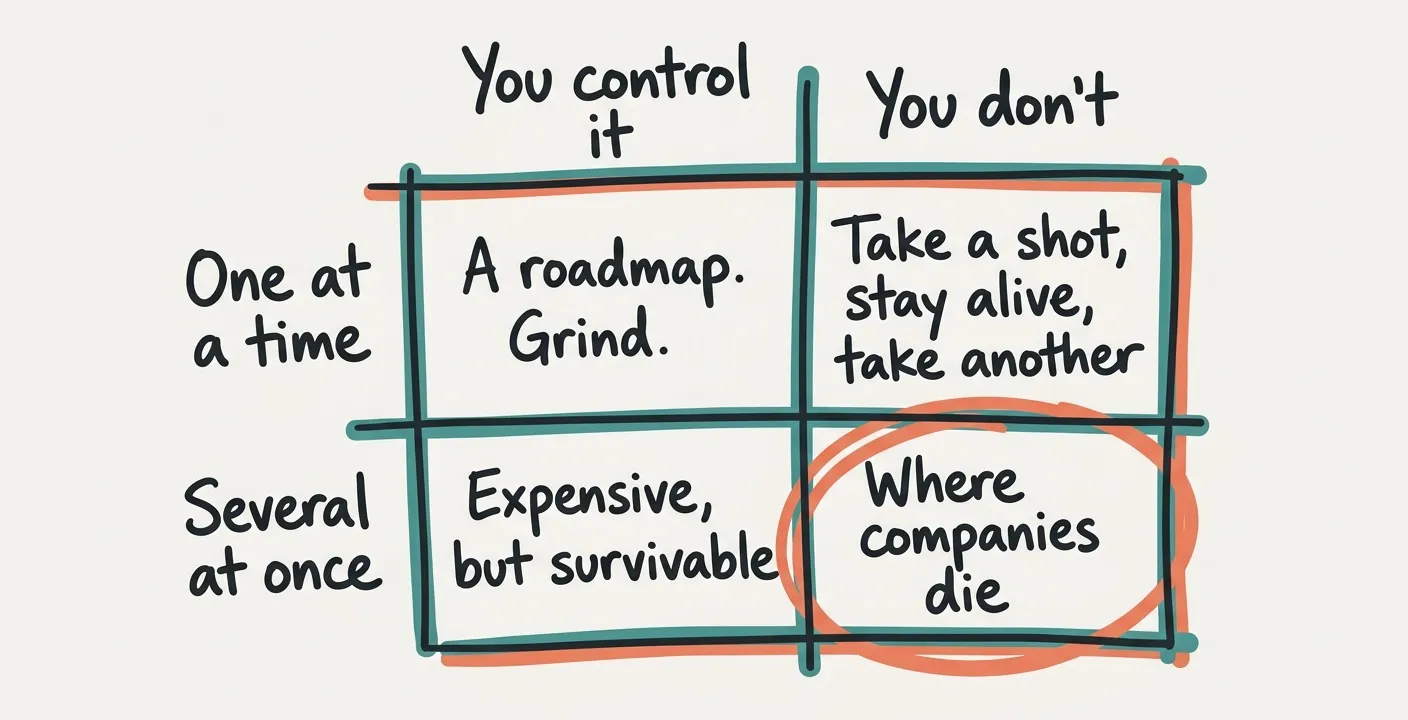
Tesla stacked as many miracles as anyone, they just never let two uncontrolled ones run at the same time. The 2006 master plan, build a sports car, use that money to build a more affordable car, use that money to build an even cheaper one, meant the engineering could grind in parallel while the market only had to answer one question at a time: first whether rich people would buy an electric sports car, later whether normal people would buy an electric saloon.
Better Place, same industry, same decade, welded two uncontrolled miracles together: drivers had to change behaviour and swap-station infrastructure had to reach critical mass, and each one was pointless without the other. They raised close to a billion dollars, and none of it could grind down either miracle, because neither was theirs to grind. Dead by 2013.
The bottom-right quadrant looks like a shortcut
My old smart home startup lived in that quadrant. We stacked three miracles: new technology, a market that barely existed, and B2B2C as the business model. The market one we repeated to ourselves for years: no one knows they want a smart home until they have a smart home.
B2B2C looked like the clever move, let a big partner’s brand and channel carry us to consumers. It’s actually two uncontrolled miracles that have to land at the same time: the partner has to buy it and the partner’s users have to love it, and you only have direct access to one of them. There’s no order available, no version where you clear one fit first.
Would we have chosen differently? Probably not, given the investors and consumers of the time, going direct was not on the menu. Sometimes the market chooses your miracle count for you. But I wish we’d sorted our miracles instead of just counting them, because the two we controlled were never the problem.